Have you ever taken out a bank loan to buy your dream house or your dream car? Ever dealt with financial debts? What if there are debts in the software development life cycle too? Never heard of them? Well, then you should definitely read this article till the end. In this article, we’ll be talking about technical debt and everything you need to know about it.
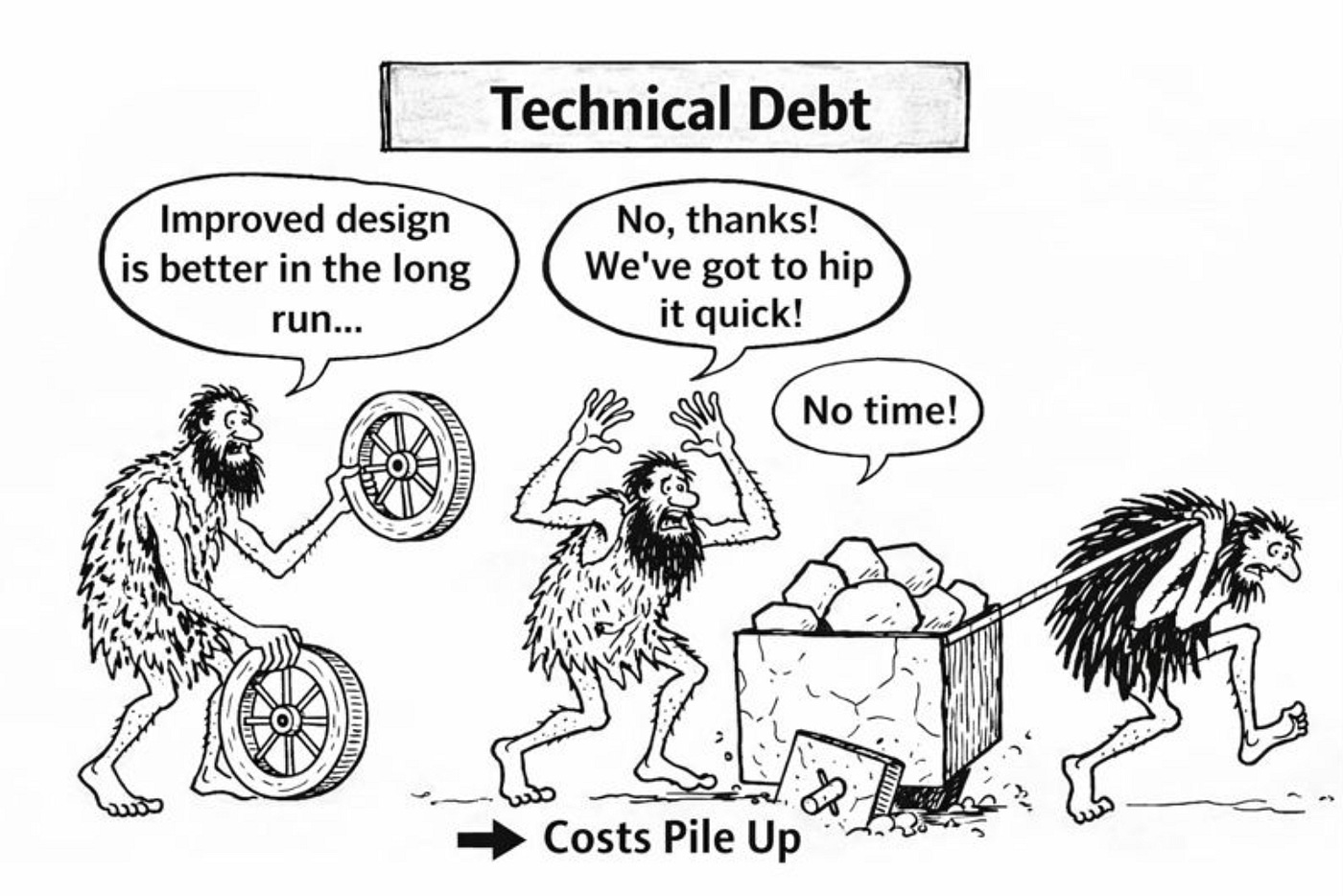
Technical debt or tech debt refers to a scenario when software teams rush to deliver a piece of software or a project and then they have to rework it later. To put it another way, it is the effect of emphasizing speed over accuracy in coding. When you take a shortcut in developing your code in order to move faster, you can end up with poorer and more complex code. Since it is similar to getting a loan, it is termed technical debt. You can acquire more today than you normally could, but you end up paying a bigger price eventually.
Certain things are more essential than others. For instance, a vehicle to travel to and from work. Sometimes people cannot simply decide to put off that investment for months or even years in order to save the money they actually need. As a result they acquire a car loan. That means they will pay more over time for the car but they will get what they need right away.
Now that we have a basic understanding of what technical debt means, let us look at the types of technical debt that might occur.
Types of technical debt
Technical debt is broadly divided into two types: planned or intentional, and unplanned or unintentional.
Planned (intentional) technical debt
Taken deliberately as a strategic tool. This type of technical debt arises when an organization makes a well-informed choice to incur debt, fully aware of the repercussions, risks, and the cost associated with it. When taking planned debt, it is necessary to be as detailed as possible about the concessions the company intends to make and how the debt will be repaid later.
Unplanned (unintentional) technical debt
A non-strategic outcome of poor practices. Unplanned technical debt occurs as a result of bad techniques, lack of knowledge of new coding approaches, rushed fixes, deployment challenges, or simply missing follow-up work. This type of debt is often the hardest to manage because it was not tracked or approved in the first place.
Is technical debt good or bad?
Let us continue with the same example as before. You take up a car loan to buy a car because it suits your need at the moment. Now although it seems to be the best decision for you, some of your friends or colleagues may differ in opinion. They may think of it as a financial burden that could have been avoided by saving money first and then planning things in a better way. Basically your decision to acquire a loan can be good or bad, right or wrong. It all depends on one’s perspective. Same goes for technical debt. It can be good or bad, right or wrong, depending on one’s perspective.
One of the most crucial factors to consider when taking out a business loan is the rate of interest. Approaching a loan shark with an excessively higher interest rate is obviously a terrible choice. The same is true for technical debt. You must calculate the amount of interest you will pay.
Technical debt is beneficial in a way if the amount you pay back is minimal and the payoff (time to market, validation, revenue) justifies the cost. Wondering how you can calculate the interest or the amount on the technical debt? Here are certain questions you need to consider:
Is this an essential element of the primary product? If yes, taking on debt could come at a very high price.
What are the future prospects? What could be the impact of technical debt on future growth and upcoming projects?
What are the consequences for the customer base?
How much will technical debt impact the user experience and product success?
So, does that mean technical debt is always a great decision? No. There are cases when technical debt ends up being more of a problem for the development team. It might lead to several issues in the software because it is already lacking in terms of quality. Even if the product releases to the market or is handed over to a client, the developers might face issues as a faulty system, eventually leading to system failures. Whoa, sounds quite challenging, right? But there has to be some solution. Let us take a look at how we can avoid and minimize technical debt.
How to reduce technical debt
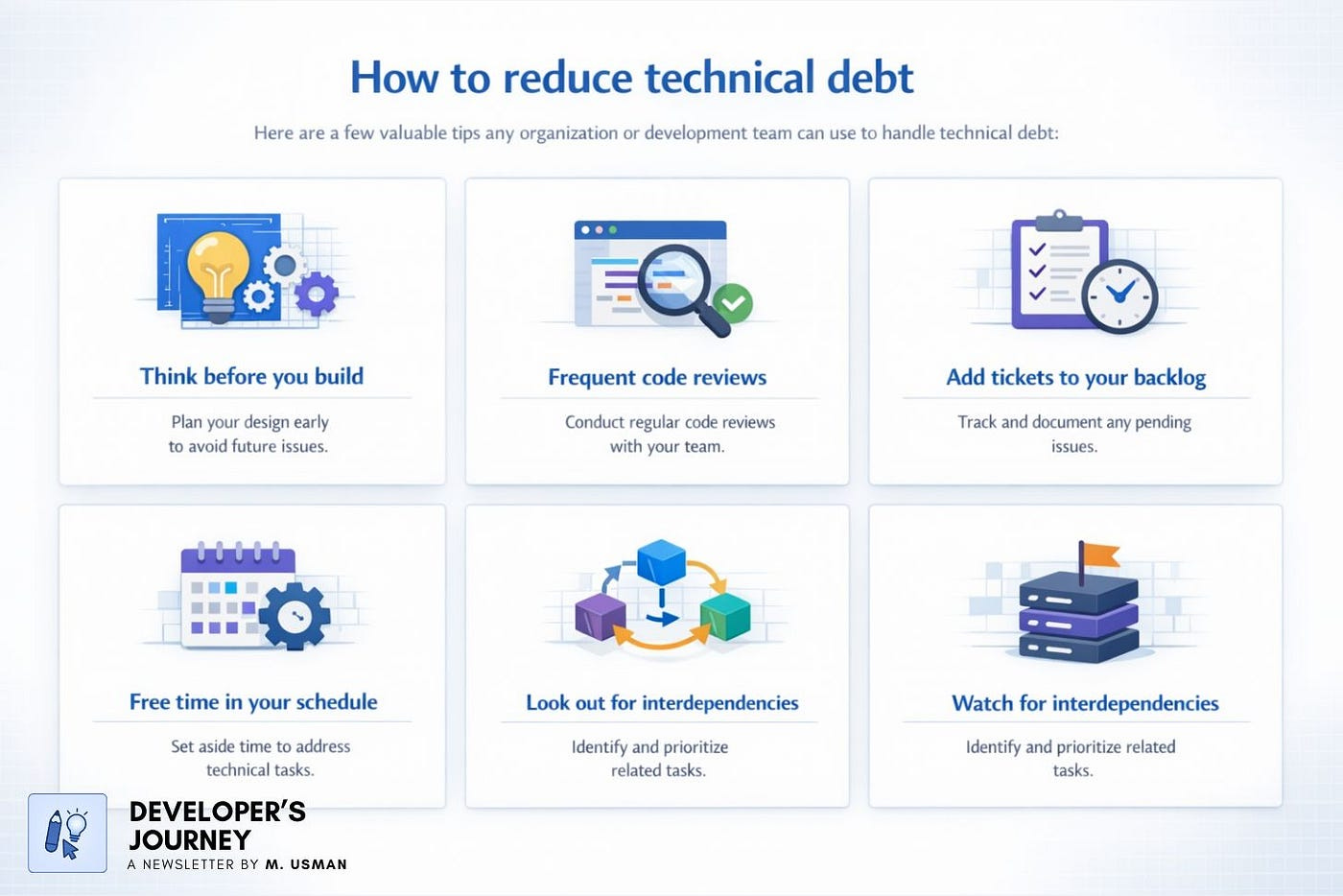
Your craft is crucial because it can outlast numerous development phases. How to avoid technical debt? Here are a few valuable tips any organization or development team can use to handle technical debt:
How to reduce technical debt infographic way
Think before you build
Thinking about your software design before you start coding in the early stages of development is the easiest method to avoid technical debt. Making changes in the initial phases is easier than dealing with complex issues later.
Another great way to reduce the chances of technical debt is having a predefined set of standards followed by the team and holding timely code reviews based on those standards. Ensuring that the entire team is responsible for code quality makes every member value and take code reviews seriously.
Add tickets to your backlog
Sometimes you cannot avoid quick fixes in the beginning. In such cases, add the debt items to your list of tasks so they are tracked. This makes it very easy to remember that these items are pending and need to be addressed within a specific time frame.
Free time in your schedule to handle debt
Allow buffer time in your planned schedule so you can take care of technical tasks. This ensures you do not panic when a technical issue comes up and you are prepared to allocate time for refactoring and fixes.
Look out for interdependencies
Interdependency means technical items that lead to one another, causing additional workloads. To avoid extra work, take note of debt items and sort them by priority. This helps you identify dependencies early and plan accordingly.
These few tips will reduce the possibility of technical debt arising in your workflow or at least allow you to manage it better. Now let us discuss some best practices to handle technical debt more professionally.
Best practices to manage technical debt
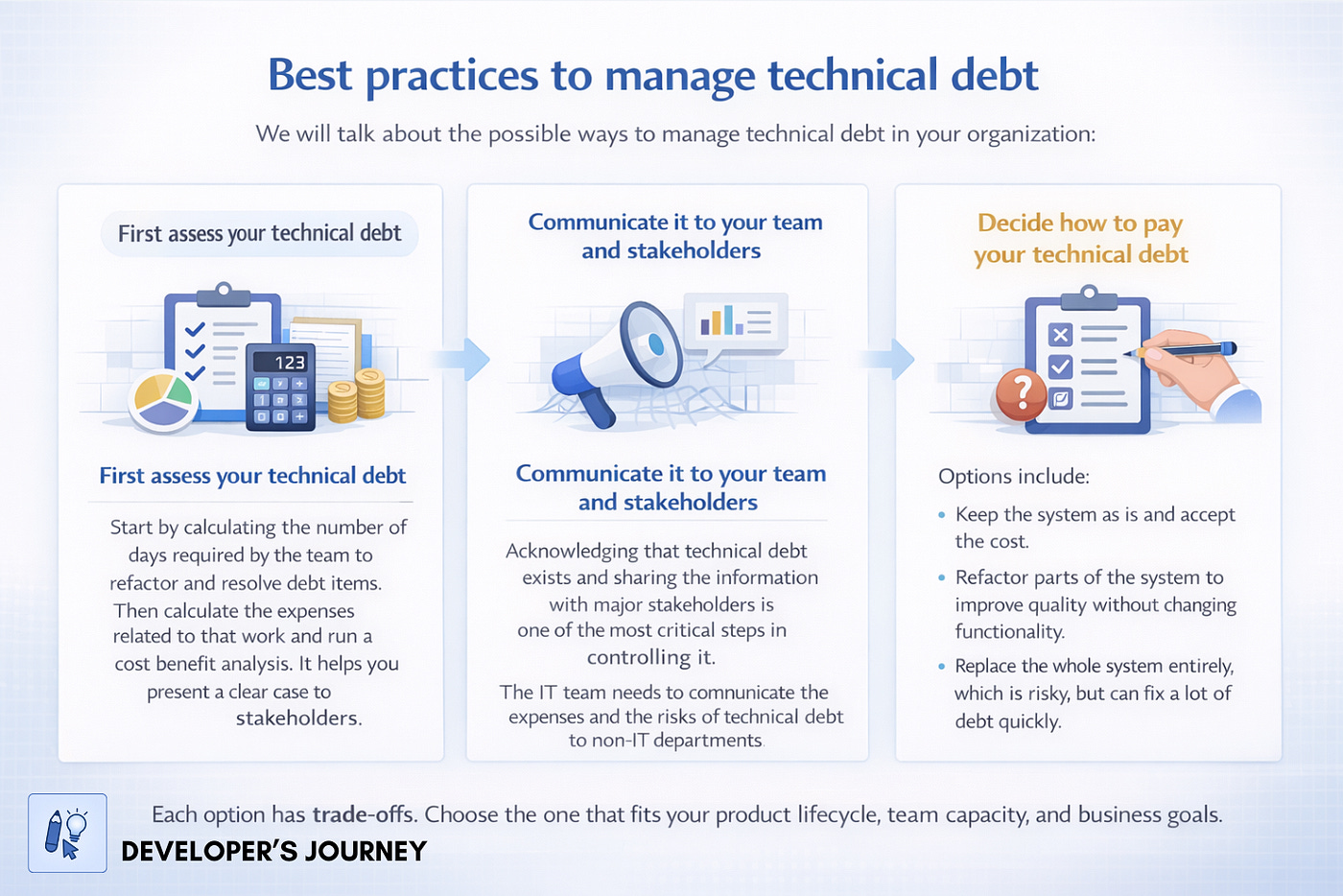
We will talk about the possible ways to manage technical debt in your organization:
Best practices to manage technical debt Infographic
First assess your technical debt
Start by calculating the number of days required by the team to refactor and resolve debt items. Then calculate the expenses related to that work and run a cost benefit analysis. It helps you present a clear case to stakeholders.
Communicate it to your team and stakeholders
Acknowledging that technical debt exists and sharing the information with major stakeholders is one of the most critical steps in controlling it. The IT team needs to communicate the expenses and the risks of technical debt to non-IT departments and agree on a plan to resolve it.
Decide how to pay your technical debt
Options include:
Keep the system as is and accept the cost.
Refactor parts of the system to improve quality without changing functionality.
Replace the whole system entirely, which is risky but can fix a lot of debt quickly.
Each option has trade-offs. Choose the one that fits your product lifecycle, team capacity, and business goals.
Concrete examples of technical debt (so you can spot it)
To make this real, here are very specific examples of technical debt you may already be living with:
Hard-coded values instead of using configuration files or environment variables.
Duplicate code copied across modules rather than creating a shared utility.
Skipping unit tests and automated tests to save time before a deadline.
Using outdated third-party libraries or frameworks and avoiding upgrades.
Quick fixes applied directly to production without proper refactoring.
Poor database schema that needs frequent migrations and complex queries.
Tight coupling between modules making changes risky and slow.
These are things developers recognize instantly and they lead to an accumulation of debt over time.
Code-level debt vs architectural debt
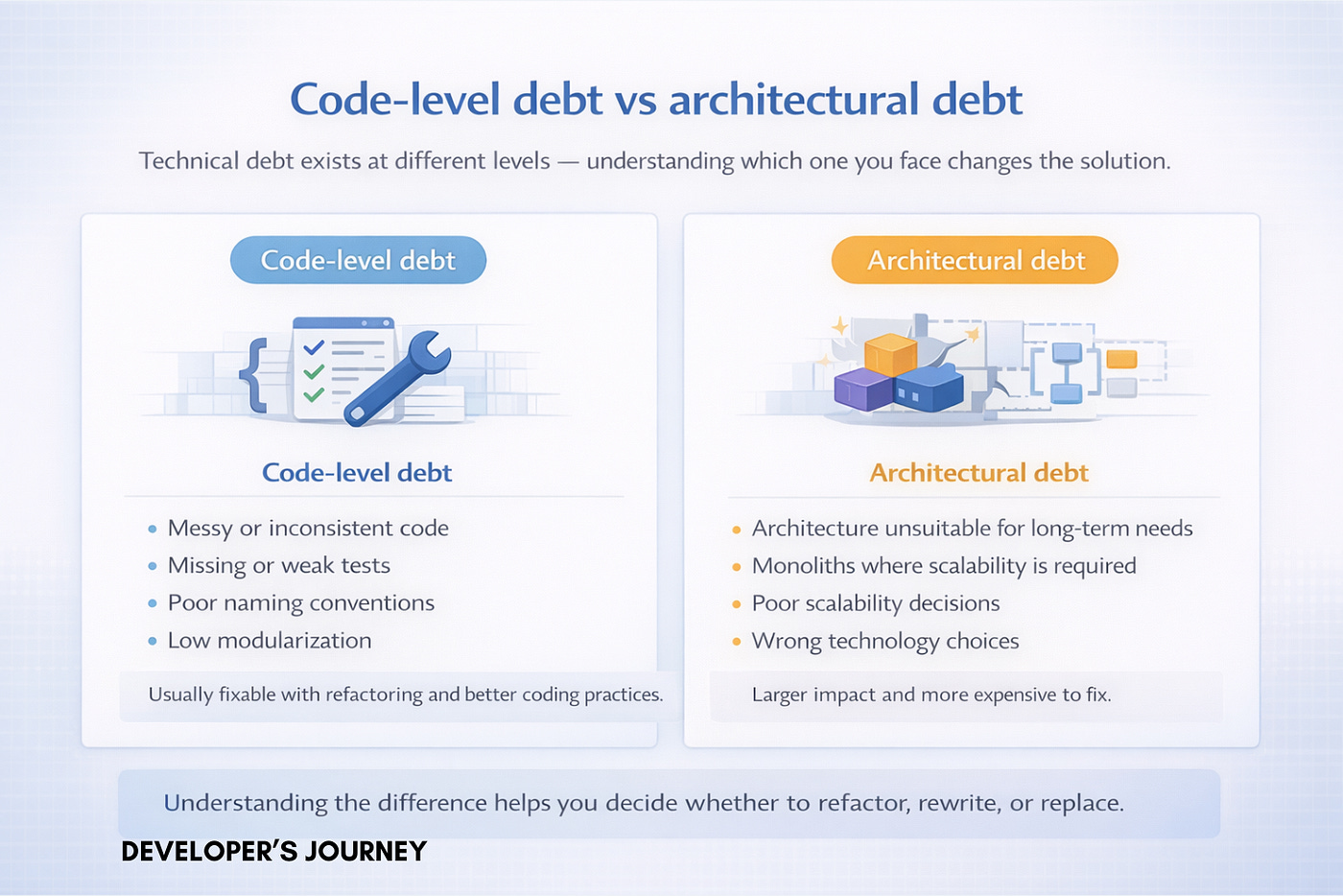
Technical debt is not only messy code. There is a useful distinction:
Code-level debt vs architectural debt infographic
Code-level debt: messy code, missing tests, poor naming, lack of modularization. These are usually fixable by refactoring and improving coding practices.
Architectural debt: wrong or unsuitable architecture for long-term needs, monoliths where microservices would be better, poor scalability decisions, or wrong technology choices. These are bigger and more expensive to fix.
Understanding the difference helps you choose whether to refactor, rewrite, or replace.
Technical debt is not just a developer problem. It affects business results:
Slower feature delivery and longer release cycles.
Increased development costs due to rework.
Reduced team productivity and morale.
Higher bug rate and poorer user experience.
Missed market opportunities because you cannot respond quickly to customer needs.
If you want non-technical stakeholders to care, always translate technical debt into business impact: time to market, cost to maintain, and risk to customers.
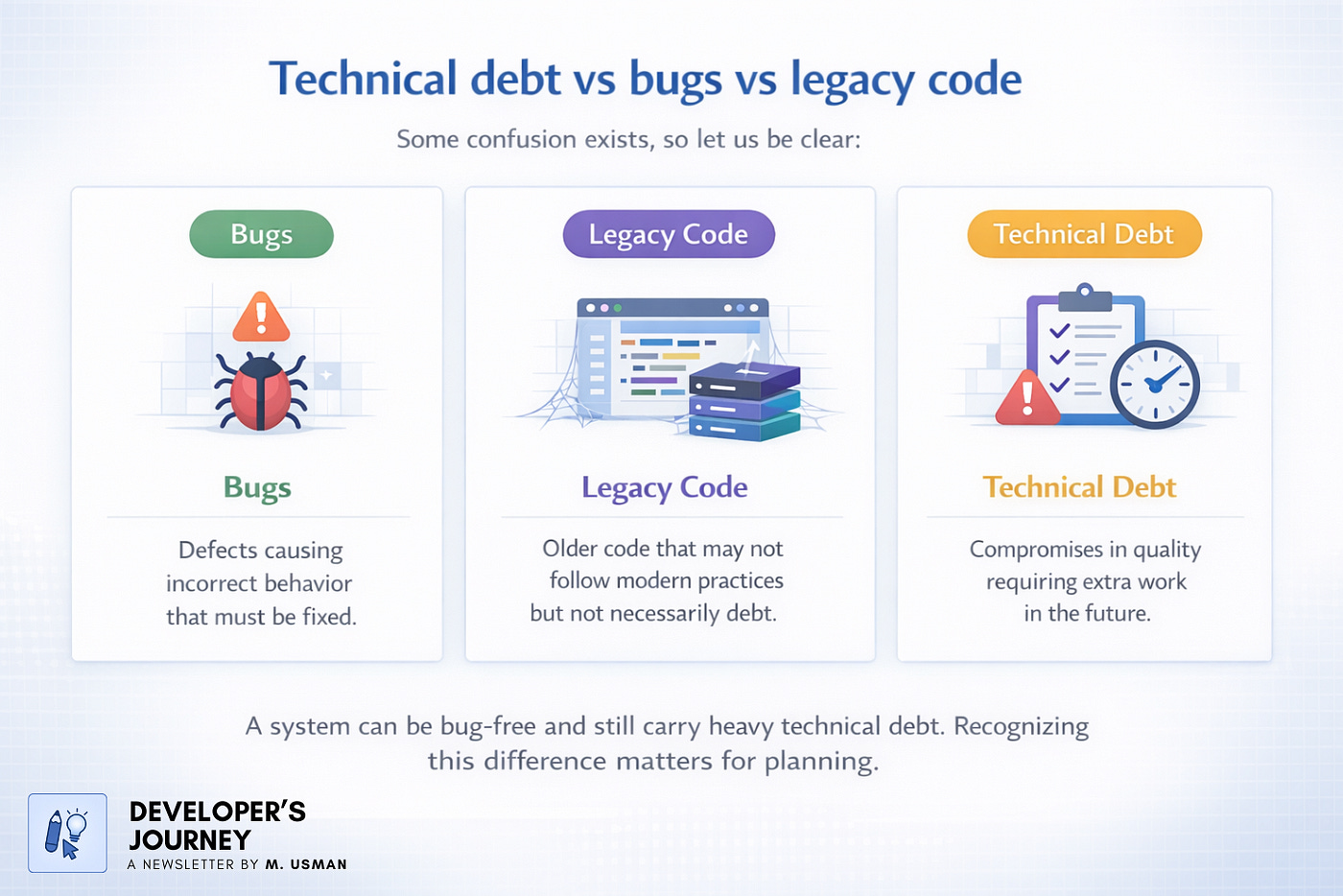
Technical debt vs bugs vs legacy code
Some confusion exists, so let us be clear:
Technical debt vs bugs vs legacy code infographic
Bugs are defects that make the software behave incorrectly. They must be fixed.
Legacy code is older code that may not follow modern practices but is not necessarily debt.
Technical debt is a conscious or unconscious compromise in quality that will require extra work in the future.
A system can be bug-free and still carry heavy technical debt. Recognizing this difference matters for planning.
Who is responsible for technical debt
Technical debt is a shared responsibility:
Developers write the code, but they often work under time and feature pressure.
Product managers and business stakeholders decide priorities and deadlines.
Engineering managers and architects set standards and allocate time for refactoring.
Debt often comes from leadership decisions. Treat it as a cross-functional issue, not just a developer problem.
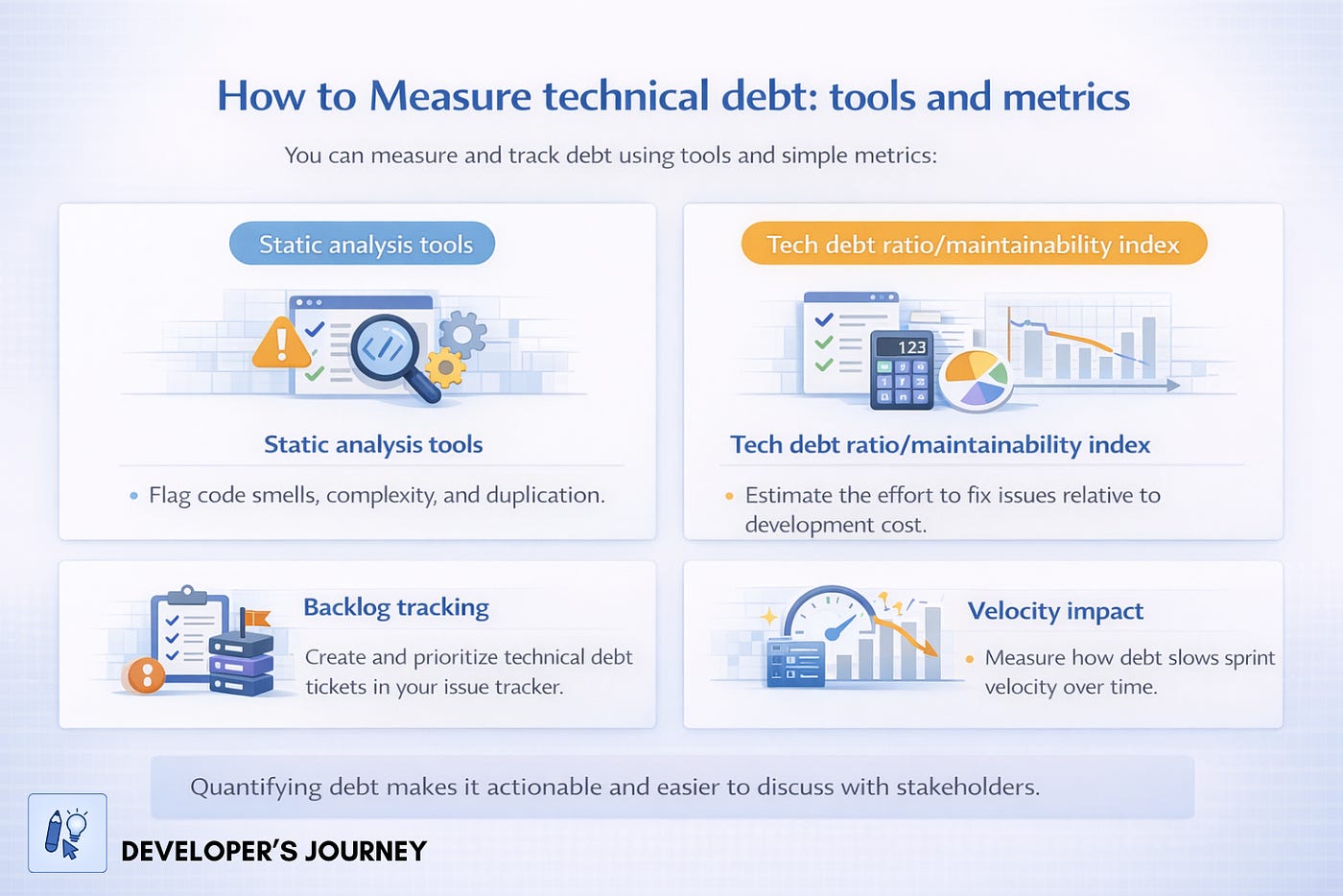
How to Measure technical debt: tools and metrics
You can measure and track debt using tools and simple metrics:
How to Measure technical debt infographic
Static analysis tools that flag code smells, complexity, and duplication.
Technical debt ratio or maintainability index concepts that estimate the effort to fix issues relative to development cost.
Backlog tracking: create and prioritize technical debt tickets in your issue tracker.
Velocity impact: measure how debt slows sprint velocity over time.
Quantifying debt makes it actionable and easier to discuss with stakeholders.
When not to pay technical debt
Paying every debt item is not practical. There are times you may choose not to pay:
Short-lived experiments or prototypes where speed matters.
Minimum Viable Products (MVPs) built to validate an idea quickly.
End-of-life software that will be sunset soon.
Decide based on product horizon, ROI, and user impact.
A healthy development culture reduces the buildup of debt:
Encourage continuous refactoring as part of regular work.
Practice test-driven development or at least maintain good automated tests.
Adopt coding standards and make code reviews non-negotiable.
Promote the mindset: leave the codebase better than you found it.
This cultural shift is the most sustainable way to keep debt manageable.
Final thoughts
Technical debt is real, common, and manageable. It can be a strategic tool when taken intentionally, and it can become a costly liability when it accumulates without being tracked. Think before you do, plan for the trade-offs, measure the costs, and build a culture that prevents unnecessary debt. With the tips and practices in this article, you will be better equipped to make the right decisions for your software and your business.
Technical debt is not always a bad thing, but only if you know you’re taking it and you communicate it clearly. Most problems start when teams don’t admit there is debt. Then it shows up later as instability, delays, and cost.
We recently worked with a client who had built a new system very quickly. On paper it looked modern, but in reality it was not stable and couldn’t be fixed. Their older legacy system was smaller, but far more reliable. So the right decision wasn’t refactoring—it was to accept the debt, move back to the legacy system, and rebuild properly. Architectural debt, once it’s wrong, usually has no shortcut. Good planning, clear requirements, and disciplined reviews reduce unnecessary debt. Not because they slow you down, but because they stop you from rebuilding the same system twice.




Insightful post.
Technical debt is not always a bad thing, but only if you know you’re taking it and you communicate it clearly. Most problems start when teams don’t admit there is debt. Then it shows up later as instability, delays, and cost.
We recently worked with a client who had built a new system very quickly. On paper it looked modern, but in reality it was not stable and couldn’t be fixed. Their older legacy system was smaller, but far more reliable. So the right decision wasn’t refactoring—it was to accept the debt, move back to the legacy system, and rebuild properly. Architectural debt, once it’s wrong, usually has no shortcut. Good planning, clear requirements, and disciplined reviews reduce unnecessary debt. Not because they slow you down, but because they stop you from rebuilding the same system twice.